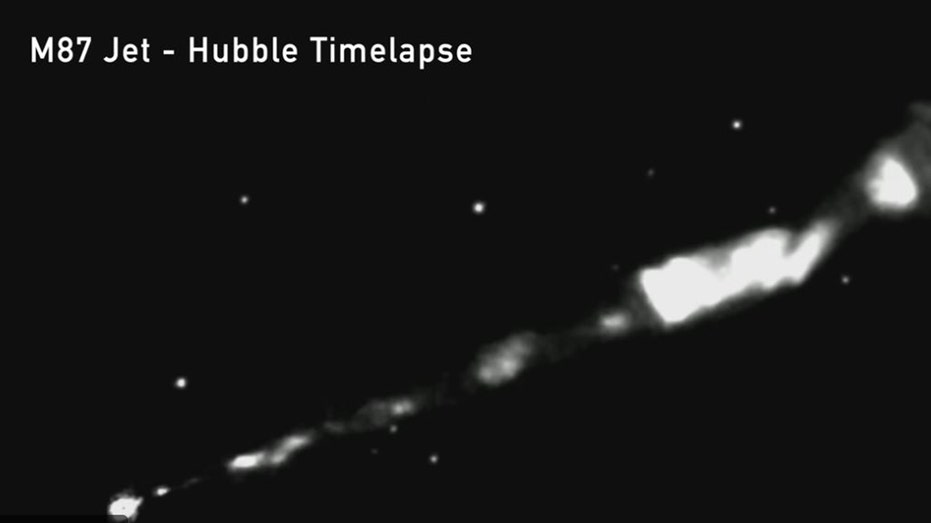
A colossal jet of energy, stretching 3,000 light-years into the cosmos, has finally revealed its origin. Scientists, using the power of the Event Horizon Telescope, have traced this spectacular phenomenon back to the very first black hole ever directly imaged – a behemoth residing in the Messier 87 galaxy.
This isn’t just about observing a distant spectacle; it’s about unraveling a fundamental mystery of the universe. How do black holes, these gravitational titans, launch streams of particles traveling at nearly the speed of light? The answer, hidden within the jet’s structure, promises to redefine our understanding of these cosmic engines.
M87, the black hole at the heart of this discovery, is anything but ordinary. It’s a supermassive entity, boasting a mass 6.5 billion times that of our sun, and located approximately 55 million light-years away. Its initial image, captured in 2019, captivated the world, but this new research delves deeper, revealing the mechanics behind its immense power.
The black hole doesn’t simply consume matter; it actively expels it. Surrounding gas and dust are drawn inward, yet simultaneously, powerful jets erupt from its poles, forming the observed stream. This dynamic interplay suggests a complex process governed by intense magnetic fields.
Researchers believe these jets aren’t constant, but rather flare up and subside. The question of whether black holes “turn on” and “off” remains a key area of investigation, with the jet’s behavior offering crucial clues. The current findings provide compelling observational evidence supporting the theory of jet launching connected to the black hole’s core.
The Event Horizon Telescope, a network of eight radio observatories functioning as a single Earth-sized telescope, was instrumental in this breakthrough. By detecting radio waves, it pierced through the cosmic veil, revealing details previously hidden from view.
The “event horizon” itself – the point of no return beyond which light cannot escape – plays a critical role. Understanding how the jet originates in relation to this boundary is paramount to understanding the black hole’s engine. This study represents a significant step towards bridging theoretical models with concrete observations.
While this research provides a robust foundation, scientists acknowledge the need for further investigation. Future observations, utilizing enhanced sensitivity and expanded telescope coverage, will be crucial for confirming these findings and refining our understanding of these extraordinary cosmic phenomena.


