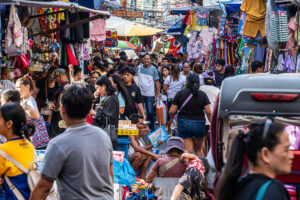
The Philippines’ economic stumble in the final months of last year exposed a critical weakness: an overdependence on consumer spending. This reliance left the nation vulnerable as growth faltered, echoing the challenges faced during the height of the pandemic.
A recent analysis revealed a concerning pattern – limited and concentrated sources of economic strength. This isn’t a new issue; the same fragility was painfully evident when lockdowns brought the country to a standstill, highlighting a systemic risk.
While household consumption continued to support the overall economy, its power wasn’t enough to prevent a significant slowdown. Had manufacturing and agriculture been thriving, the impact could have been considerably lessened, offering a crucial buffer.
The most recent quarter saw the weakest economic growth in sixteen years, registering a mere 3%. This sluggish performance was driven by declines in household spending, government investment, and overall economic activity, painting a stark picture of the current situation.
For the entire year, the economy grew at a rate of 4.4%, the lowest in five years. This mirrors the economic contraction experienced during the pandemic and subsequent lockdowns, demonstrating a recurring pattern of vulnerability.
Household consumption, which fuels over 70% of the nation’s economic activity, slowed dramatically to 3.8% in the fourth quarter. This marked the weakest performance since the initial shock of the pandemic in early 2021.
Agriculture, forestry, and fishing saw modest growth of 1%, while the industrial sector actually contracted by 0.9%. Manufacturing, a key component of industry, managed only a 1.6% increase, underscoring the broader weakness in production.
The core issue, experts say, is a lack of diversification. The Philippines must cultivate multiple engines of growth to withstand future economic shocks and avoid being overly reliant on consumption and government expenditure.
Even a return to normal government spending levels won’t solve the underlying problem unless the country actively broadens its economic base. A more resilient economy requires a wider range of thriving sectors.
However, strategic government investment could play a vital role in restoring confidence among both investors and consumers. Focused spending, directed towards key areas, could help reignite economic momentum.
Looking ahead, a modest recovery is anticipated in 2026, with growth projected to reach 5.1%, potentially gaining traction in the latter half of the year. This hinges on a combination of factors, including improved investor sentiment and consumer confidence.
Furthermore, there’s growing expectation of monetary policy easing, with potential interest rate cuts on the horizon. The delayed economic rebound and stable inflation create an environment conducive to lower borrowing costs.
Analysts suggest the central bank may consider a rate cut at its next meeting, and potentially another later in the year, especially if growth remains subdued and inflation stays within target. The current benchmark interest rate stands at 4.5%.
The central bank has already lowered borrowing costs by a cumulative 200 basis points since August, signaling a proactive approach to stimulating the economy. Further cuts could bring the key policy rate to its lowest level in three and a half years, potentially reaching 4%.
The central bank’s next policy-setting meeting is scheduled for February 19th, a crucial moment for assessing the economic landscape and charting a course for future monetary policy decisions.