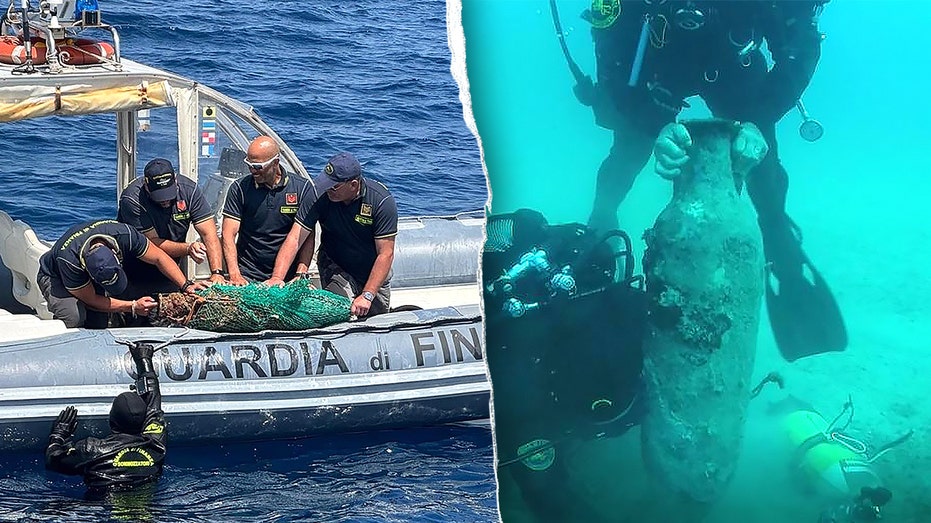
The Ionian Sea surrendered a secret this past June – a remarkably preserved Roman merchant ship, resting silently on the seabed off the coast of Apulia, Italy. It wasn't treasure hunters who found it, but the vigilant eyes of the Guardia di Finanza, Italy’s financial police, during a routine patrol.
Advanced sonar equipment detected an unusual anomaly, a subtle disturbance hinting at something extraordinary hidden beneath the waves. For months, the discovery remained confidential, shielded from public view while authorities meticulously planned their next steps.
The vessel dates back to the late Imperial era, a tumultuous period spanning from 284 A.D. to 641 A.D. – a time that witnessed the decline and eventual fall of the Western Roman Empire. It’s a snapshot of a world in transition, frozen in time by the sea.
The ship’s hold wasn’t filled with gold or jewels, but with hundreds of amphorae, ancient ceramic jars. These weren’t carrying wine or oil, however, but *garum* – a pungent, fermented fish sauce that was the ketchup of the Roman world, a staple condiment for emperors and commoners alike.
The location of the wreck is being closely guarded, a deliberate measure to protect it from looters and ensure the preservation of this invaluable archaeological site. Constant surveillance by the Guardia di Finanza’s naval operations section in Gallipoli is maintaining a protective watch.
Currently, a team of experts is meticulously surveying and documenting the wreck, employing cutting-edge investigative techniques to unlock the ship’s secrets. They hope to recover more of the cargo, piecing together a more complete picture of Roman trade and daily life.
This discovery isn’t an isolated incident. The Mediterranean Sea continues to yield its ancient past, offering glimpses into lost civilizations. Just last year, Turkish divers unearthed a 2,000-year-old shipwreck brimming with remarkably well-preserved ceramics.
Each wreck is a time capsule, a fragile link to the people who sailed these waters centuries ago. They offer a unique opportunity to rewrite history, revealing details about commerce, technology, and the lives of those who shaped the ancient world.