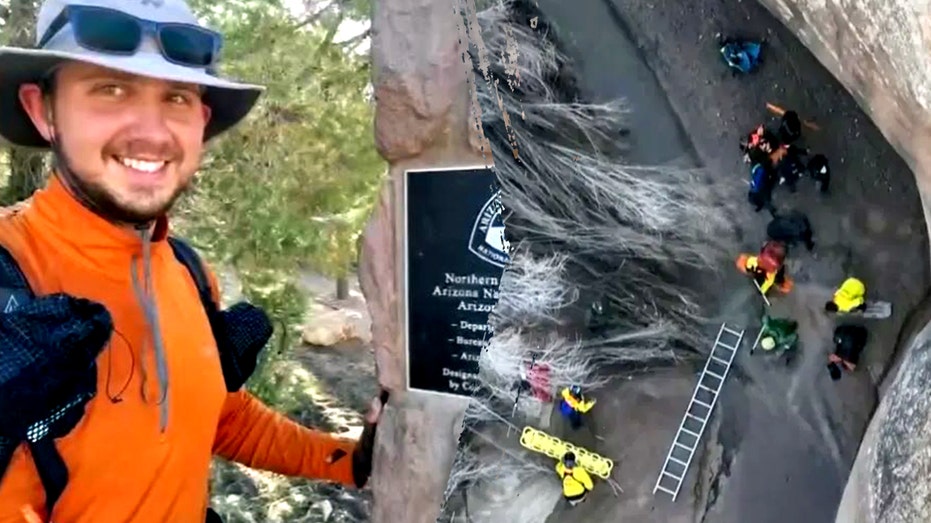
The cold bit through Austin Dirks’ layers as the first hint of sunrise painted the Utah desert. A seasoned hiker, comfortable with thousands of miles under his boots, he was navigating the upper reaches of Courthouse Wash in Arches National Park. Then, without warning, the ground vanished beneath his left foot.
It wasn’t a fall, but a slow, terrifying surrender. He managed to wrench his leg free, only to have the opposite side instantly succumb. The sand gripped like concrete, hardening around his knee, locking him in place. Even the slightest movement was impossible; he was utterly trapped.
Panic threatened to overwhelm him, but years of wilderness experience kicked in. Dirks activated his GPS satellite messenger, sending a pinpoint location to emergency services. The message was sent, but the wait felt like an eternity, stretched out in the frigid air.
Two hours passed, each one an agonizing test of endurance. He remained suspended at a precarious 45-degree angle, the temperature plummeting to a bone-chilling 20 degrees. Just as despair began to creep in, a distant hum broke the silence – the whir of a rescue drone.
The sight of the drone, and then the rescuers descending into the canyon, was a wave of relief. Watching them work to free him, Dirks realized the gravity of his situation. “I realized that’s the closest I’ve ever come to dying,” he later confessed, acknowledging the debt he owed to his rescuers.
Before this ordeal, quicksand had existed for Dirks as a cinematic trope, a dramatic device from old movies. He’d dismissed it as folklore, a legend spun for entertainment. The reality, he discovered, was far more insidious and terrifyingly real.
True quicksand isn’t the swallowing vortex portrayed in Hollywood. It’s a dense, unstable mixture of sand, water, and often clay, created by rising groundwater. While it lacks the strength to support weight, it also won’t allow a person to sink completely. Human buoyancy prevents that.
“How it’s depicted on TV is nothing like it is in real life,” Dirks explained, forever changed by his experience. The human body, he learned, is naturally more buoyant than the quicksand itself, offering a sliver of hope even in the most desperate circumstances.
Experts emphasize a crucial survival technique: lean back. Spreading your weight across a larger surface area can relieve the pressure and allow for gradual movement. It’s a counterintuitive response, but one that can be the difference between escape and a prolonged, terrifying struggle.